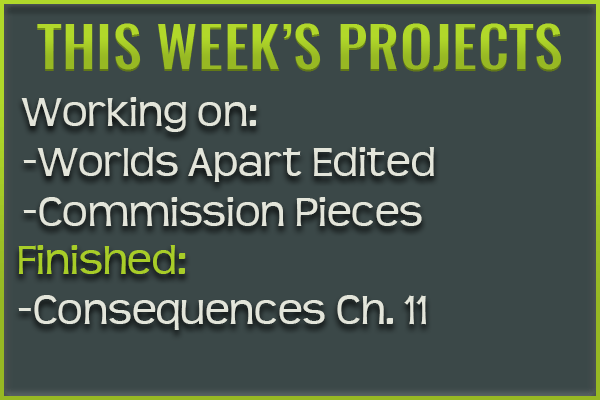
Sorry for the delay! My WordPress account was acting up, so the chapter got posted a tad late. That said, Consequences Chapter 11 is live now, and available for your reading pleasure!
I’ve departed from my older style in an interesting way. I’ve likened my writing to television episodes before, both in the fact it’s episodic by nature (and timing) and in the way I frame narrative. That said, in terms of dialogue I think I’ve begun to see my writing more and more like that of a theater play.
Truth be told, in a way, I’ve already seen my writing this way. There are certain scenes that are dominated not by action, but by monologue. Very early in this latest chapter, you see such a scene play out between Megan and Adam. A cynic might read this scene and say “it’s too much dialogue, there’s not enough action, show don’t tell!” I actually disagree with this.
Number one, telling is both a great way of conveying information and emotion, as well as real. People act like a character telling another character how they feel is somehow automatically bad writing, but… people, especially high schoolers, tell each other how they feel all the time. People in the real world monologue. We even have terms for it – venting or trauma dumping. People will say “I’ve been feeling down lately. Can I tell you why?” And yet when we write these things down, they’re “bad writing”? Seems silly.
Number two, telling kind of is showing if you do it right. Now, I absolutely might not do it right, and I certainly don’t always do it right, but a character explaining their motives to another character redefines their previous actions. For example, Megan’s scene with Adam actually reveals a lot about her actions since her breakdown. She explicitly tells him one instance (standing up to Nicole) but clever readers can probably already tell this re-contextualizes a few others. I do this constantly – not because I think it’s particularly good or whatever, but it just happens to be part of my style. Odds are, if you like my writing enough to bother reading my blog posts, you likely enjoy it, so I’m glad it has its audience.
One downside to these scenes, and my subsequent style evolution wherein I tend to use more filler words, means that a chapter of the same length might not have as many scenes. This chapter breaks that tradition a bit, but it doesn’t quite capture a particular magic of Being More Social. A reader critiqued my writing a chapter ago as not containing enough events, and I think I agree with them. I like when characters have events happening to them, rather than just talking. Double points if these events are where certain developments go down, rather than just through conversation. Implementing that critique is a process; evidently a slow one, but it is something I’ve noted.
One strategy I’ve used is implementing new locations. Usually that spices things up. I loved re-integrating that one useless hike scene from BMS where Adam basically was a misogynist to his girlfriend; now, it’s a place that matters deeply to both of them. As well, using Sabrina’s house as well as its, ahem, limitations, was fun in and of itself. I have a strategy, and it seems to work for at least my own enjoyment. Whether it works for the story is not up to me.
Ultimately, I’m writing a larger story, so some chapters will be better than others. Some will contain more action than others. Some chapters will set up later chapters, and as a result, you’ll have to judge this story twice – once, chapter-by-chapter, and once, as a whole product. You might be surprised how differently the story comes across when the perspective shifts. I’ll talk to you all next week.
 Bashful Scribe